
Mino Bimaadiziwin – Living a good life
YMCAs across Canada are unanimously dedicated to truth and reconciliation with Indigenous peoples from coast to coast to coast. Reflective of our commitment to fostering belonging, our values of accountability, collaboration and inclusiveness include a statement of reconciliation.
As we welcome the world to Toronto (Tkarón:to), Ontario (Kaniatarí:io), Canada for the 21st YMCA World Council in July 2026, we are pleased to share some foundational teachings that influence our relationship with these territories.
Our hope is that all guests will find these teachings meaningful and applicable to your work in Canada and back in your home Nations.
The Seven Grandfather Teachings
Guiding and foundational principles, rooted in Anishinaabe teachings
In Anishinaabe/Ojibwe culture, oral traditions are foundational; teachings and stories are shared, passed down from generation to generation. The Seven Grandfather Teachings, foundational to many First Nations on this territory, are also passed on in this way. Each teaching is represented by an animal that gives us an understanding of how we should live on Mother Earth.
While there may be variations from Nation to Nation, the Seven Grandfather Teachings come from the same core message; these 7 guiding principles are moral steppingstones that form a cultural foundation of a shared respect for all living things, without conflict.
Making the Connections
The seven primary principles for a good life, The Seven Grandfather Teachings, align closely with the 4 Pillars of Impact of YMCA Vision 2030: Community Wellbeing, Meaningful Work, Sustainable Planet, Just World.
Living for the wellbeing of your community, using our skills in a meaningful way, sustaining our planet for this generation and all future generations and to advance peace and balance in this world are shared, harmonious and unifying aspirations.
Read more about the 4 Pillars of the global YMCA Vision 2030.
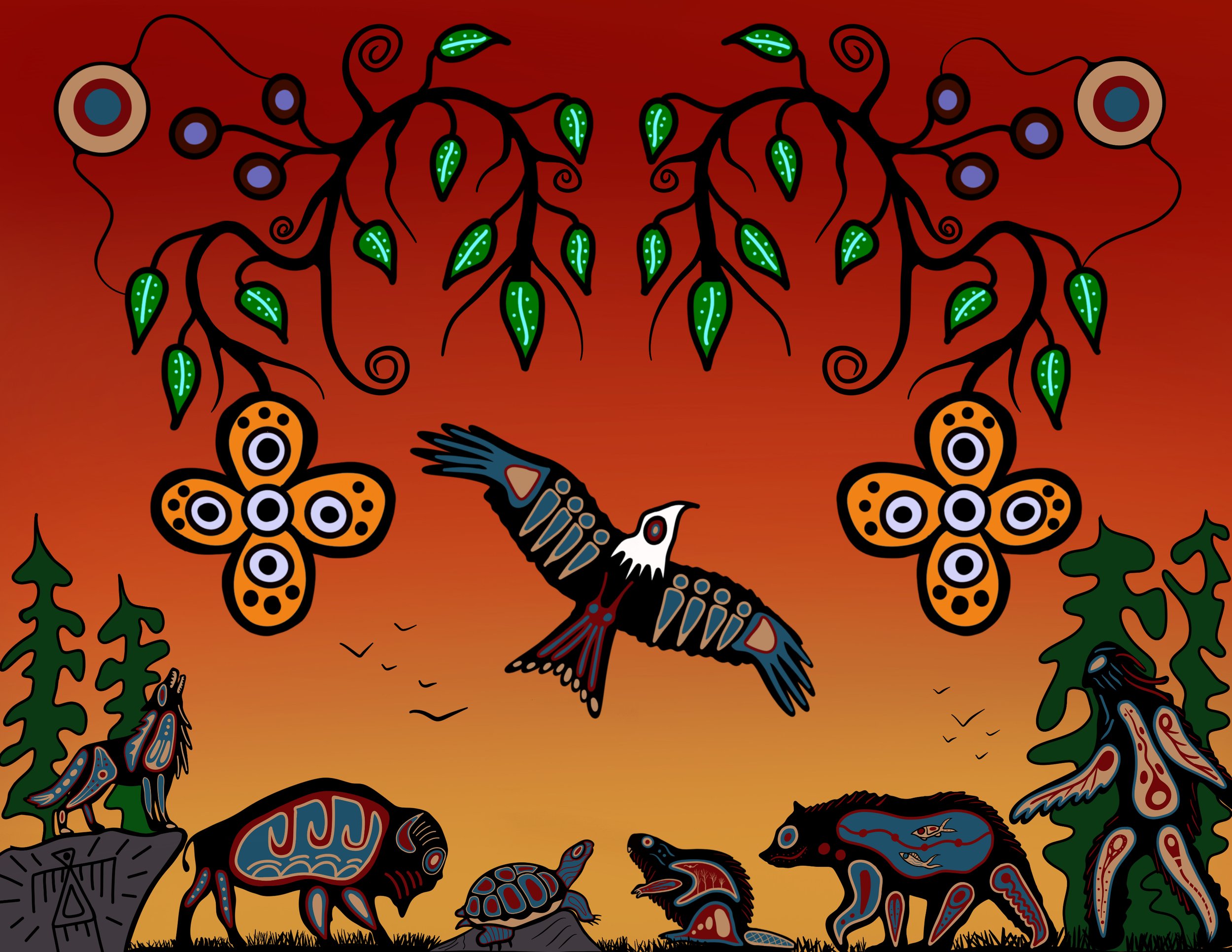
The Seven Grandfather Teachings can be taught through the observations of the animal world. Each teaching is linked to an animal that embodies and models a specific virtue.
The artwork above, by Anishinaabe artist Cody James Houle (Houle Fine Art), illustrates the animals that represent each of the teachings.
-
Deb = to a certain extent
We = sound through speech
Win = a way it is done
Represented by the Turtle, this teaching emphasizes both the journey and the destination. Slow, steady and meticulous, the Turtle reminds us to be true to ourselves and all other things. Truth is sometimes hard to face, but once accepted, the truth can open opportunities to make positive changes.
-
Dabas = low or lower
End = pertaining to thought
Izi = state or condition
Win = a way it is done
Represented by the wolf, this teaching reminds us to find balance with the world around us, to live selflessly, respecting your place within a larger ‘whole’. Humility is not only individual but how we impact our community. Humility allows us to be good global citizens, doing good work at the community level.
-
Manaaji = to go easy on someone
Idi = in a reciprocal way
Win = a way it is done
Represented by the Buffalo, this teaching is a reminder to honour all of creation, to reduce waste and to live life in balance with the natural world around us. Share and take only what you need. Buffalo have a complex history on this continent; having gone from thriving, to decimated, and being used as a tool of control. Traditionally, the Buffalo gave every part of itself to the people to sustain us, so this teaching reminds us to respect balance, nature and the needs of others.
-
Zaag = to emerge, come out or flow out
Idi = in a reciprocal way
Win = a way it is done
This teaching is represented by the Eagle; the bird with the ability to fly the highest, closest to the heavens and with the insight to see great distances. The Eagle has the strength to carry all other teachings. This teaching reminds us that to love yourself and your neighbour is to know peace. It is also a reminder, once again, to all and care for all of Creation, in balance and with care for all.
-
Gwayak = correctly, straightly, and rightly
Aadizi = he/she lives
Win = a way it is done
This teaching is represented by the Raven as a reminder to accept and use the gifts that we have been given to thrive and survive. Be honest with yourself by recognizing and accepting who you are. Do not try to seek power, speed or beauty of others. Speak honestly and from your heart. (In some teachings, Gwayakwaadizwin is represented by Sabe, also known as Big Foot.)
-
Zoongi = solid, strong
De’e = a form of heart
Win = a way it is done
This teaching is represented by the bear, who stands tall. Like the mother bear, use your courage and bravery to face your fears and protect those younger or vulnerable. To face life with this courage is to be brave. Find strength within, face the challenges in front of you and defend what is right and just in your communities. Listen to your heart. It takes courage to do what is right.
-
Ni = the soul within
Waa = pertaining to sight
Kaa = an abundance
Win = a way it is done
The beaver represents the wisdom to use your natural talents wisely, for the survival of yourself, your family, and your community. The beaver alters the environment in a sustainable way. This teaching reminds us to live our lives with a clear vision, build a peaceful world, and respect the limitations of yourself and your surroundings.
For complete teachings, please visit this link https://www.7generations.org/seven-grandfather-teachings
Learn More
The Indigenous History of Tkaronto (now commonly referred to as Toronto)
The National Centre for Truth and Reconciliation (The NCTR is a place of learning and dialogue where the truths of the Residential School system and experience will be honoured and kept safe for future generations.)